Today we have another guest post by Ron Robins, founder and analyst of Investing for the Soul. Ron’s post warns of some of the dangers of governments trying to manipulate currency markets. This subject is the current cause of much tension between the U.S. and China and is also driving uncertainty on Wall Street and the precious metals markets.
Market manipulations eventually led to Soviet economic collapse. Though not as overt as the Soviets, it is the manipulation of currencies and interest rates by major economic powers that has mostly led to massive misalignments is investment and consumption that pose extraordinary dangers to global economic health.
Ask anyone if they believe that the Chinese currency, the renminbi, is manipulated. Almost everyone agrees that it is. Are US interest rates manipulated? Again, everyone knows they are. (Not too long ago it was only the short term rates that were controlled. Now the US Federal Reserve [the Fed] is buying longer dated US treasury bonds to bring their rates down too.) Countries all over the world are manipulating their currencies lower to gain export advantages and maintaining near zero interest rates to spur domestic demand and cheap government borrowing.
It is basic economics that where markets are manipulated, supply and demand are distorted. And one distortion creates the need for a further distortion, and so on. The longer the distortions continue the greater the possibility of total market failure. We are near that point today with currencies and interest rates.
The Chinese have scored a major mercantile advantage by pegging their currency, the renminbi, at a relatively set and undervalued rate to the U.S. dollar. Not only have US exports suffered, but the exports of many other countries have suffered as well. Under US law, the Chinese should probably have been labeled a “currency manipulator.” However, by bowing to Chinese demands that they not be labeled a currency manipulator, President Obama’s administration is losing credibility everywhere.
So, Americans are waking up to find that not only does China dictate U.S. foreign exchange policy, but China indirectly influences its domestic economic agenda as well. Everything from employment policies (export expansion) to government funding needs (requiring Chinese funding) are all partly defined by the present exchange rate policies.
Increasingly, Americans realize that on the foreign exchange front they have been “checkmated”-as in the game of chess-by China. Should difficult economic times continue, or worsen, increasing American anger is likely at this arrangement. It could pass the breaking point and encourage America to act unilaterally against China. Currency turmoil might then embrace the globe.
However, one never discussed but possible reason why the US government has been afraid to label China (and Japan previously) as currency manipulators may be because the US itself may be acting covertly to manage the dollar exchange rate.
According to the US government’s own legislation, it can act secretly in currency exchange markets to affect the dollar’s exchange rate using the Treasury’s Exchange Stabilization Fund (ESF). The US Treasury say that the ESF, “with the approval of the President, may deal in gold, foreign exchange, and other instruments of credit and securities.” The ESF was established by the Gold Reserve Act of 1934 and then amended in the late 1970’s.
Also, the Fed engages in opaque currency “swaps” with other nations, and there is significant evidence of U.S. Treasury and Fed engagement in gold price suppression. Gold is the “anti-dollar” and barometer of confidence in the dollar. (See my August 24 column, “The Ethics of Gold,” at http://english.alrroya.com/node/54671 and gata.org)
Another manipulation of the Fed is its control of short term rates-and now possibly long term ones as well-to smooth out the booms and busts of the economy. However, we see the falsity of this argument. After almost two years at a near zero per cent federal funds rate the US economic quagmire continues-or worsens.
Induced low rates over the past ten years or so created a massive real estate boom and bust, discouraged savings, led to inordinate financial risk taking and moral hazard, unsustainable consumer debt, and now excessive, possibly uncontrollable government deficits and debt.
In their seminal work, “Growth in a Time of Debt,” published January 2010, Professors Carmen M. Reinhart and Kenneth S. Rogoff found that when government debt/GDP ratios exceed 90 per cent, economic growth rates fall considerably. According to the BIS, U.S. government debt/GDP will be 92 per cent by the end of 2010 and 100 per cent in 2011.
Furthermore, on September 1, the International Monetary Fund said, “general government debt in the G-20 advanced economies surged from 78 per cent of GDP in 2007 to 97 per cent of GDP in 2009 and is projected to rise to 115 per cent of GDP in 2015.”
Unfortunately, the present and future private deleveraging of debt in the U.S. and some other developed countries means potentially continued high-or higher-government deficits as economic growth is retarded or declines further. The Fed has said that to counter any renewed softness in US economic activity it will significantly expand its purchase of US government bonds and possibly other assets. This has the potential for fueling a huge expansion of the money supply and creating high or even hyperinflation.
The U.S. and some other countries are following a path whereby every manipulation begets further manipulation, and which then begets even further manipulation. With China, perhaps Japan again soon, and other countries controlling their currency values, the U.S. may be forced overtly or covertly to counter their currency manipulations. And with continuing economic difficulties, with interest rate policy having created a debt nightmare and becoming increasingly ineffective, the Fed may institute money proliferation policies that have the possibility of leading to high or ever hyperinflation.
If a vicious circle of manipulations by US authorities and other countries occurs, given time, it might rival some aspects of the soviet command economy-and with a possibly similar tragic outcome. Hopefully, Americans and others wake up before it is too late and realize that manipulated markets can eventually cause ruin.
E-mail the writer: r.robins@alrroya.com
©alrroya.com
See the original post of this article at: http://english.alrroya.com/node/58753
Showing posts with label real estate. Show all posts
Thursday, October 21, 2010
Tuesday, October 19, 2010
Is MERS nothing but a scam?
MERS stands for Mortgage Electronic Registry System. This system was set up by banks and other financial institutions specifically to save themselves time and fees when selling mortgages to each other. It was intended from the very beginning to make an end-run around the requirement in every local jurisdiction in the country to transfer and record the original mortgage loan paperwork with each and every transaction. The headline on their web site home page says “Process loans, not paperwork.” They seem proud of being “created by the real estate finance industry.” MERS “eliminates the need to prepare and record assignments when trading residential and commercial mortgage loans.”
The problem is all those local and state laws still on the books everywhere across the entire country that do require the preparation and recording of assignments when trading any mortgage loans. It seems like everyone just decided to look the other way while the financial companies made things much easier and cheaper for themselves. To make things even worse, by no longer properly recording the mortgage loan assignments state and county registrars are shielded from knowing who the true owner is. Mortgage loans transferred through MERS list MERS as the mortgagee even though they don’t hold title to the land.
Which brings up another problem with MERS. Many of MERS member companies have MERS carry out foreclosures in MERS’s name. This despite the fact that MERS does not own legal title to the mortgages. MERS therefore lacks legal standing to foreclose. Foreclosure courts have a very difficult time disputing this because the mortgage loan assignments are not recorded so the actual owner cannot be found.
All of the above is further complicated by the fact that MERS has no employees. This means all actions taken by the company are out-sourced to third parties. The third parties are usually document processing companies such as LPS or DOCX or large attorneys’ offices specializing in document processing. Yes, the same ones under so much scrutiny in Florida and around the country for questionable signature, verification practices and notary stamps.
Given the way the real estate crisis has played out during the past few years, it is hard not to wonder if MERS wasn’t a planned scam from the first. If the financial companies wanted to be able to sell and trade and securitize mortgages as quickly as possible without scrutiny, what better way than to remove those sales and trades from public view. The true legal owners of any given mortgage loan could no longer be tracked down through any public records. No government regulators could track how or when or how often mortgage loans were assigned. It was as if a huge segment of the mortgage industry got sucked into a black hole never to be seen again. Until people started to default on those “hidden”, “off-the-books” mortgages, of course.
The problem is all those local and state laws still on the books everywhere across the entire country that do require the preparation and recording of assignments when trading any mortgage loans. It seems like everyone just decided to look the other way while the financial companies made things much easier and cheaper for themselves. To make things even worse, by no longer properly recording the mortgage loan assignments state and county registrars are shielded from knowing who the true owner is. Mortgage loans transferred through MERS list MERS as the mortgagee even though they don’t hold title to the land.
Which brings up another problem with MERS. Many of MERS member companies have MERS carry out foreclosures in MERS’s name. This despite the fact that MERS does not own legal title to the mortgages. MERS therefore lacks legal standing to foreclose. Foreclosure courts have a very difficult time disputing this because the mortgage loan assignments are not recorded so the actual owner cannot be found.
All of the above is further complicated by the fact that MERS has no employees. This means all actions taken by the company are out-sourced to third parties. The third parties are usually document processing companies such as LPS or DOCX or large attorneys’ offices specializing in document processing. Yes, the same ones under so much scrutiny in Florida and around the country for questionable signature, verification practices and notary stamps.
Given the way the real estate crisis has played out during the past few years, it is hard not to wonder if MERS wasn’t a planned scam from the first. If the financial companies wanted to be able to sell and trade and securitize mortgages as quickly as possible without scrutiny, what better way than to remove those sales and trades from public view. The true legal owners of any given mortgage loan could no longer be tracked down through any public records. No government regulators could track how or when or how often mortgage loans were assigned. It was as if a huge segment of the mortgage industry got sucked into a black hole never to be seen again. Until people started to default on those “hidden”, “off-the-books” mortgages, of course.
Labels:
default,
document processing,
docx,
legal title,
lps,
mers,
mortgage,
real estate,
scam
Saturday, October 16, 2010
Real Estate Investors start to feel the effects of foreclosure fraud
There is a wide, deep, blue sea of foreclosure problems just starting to be explored. Investigations into foreclosure fraud by the federal government, state governments and the lending banks have had major effects on the real estate world. Until very recently there had been little to no change at the local level. That has changed during the past week.
Real estate investors and others purchasing property at courthouse auctions are seeing large portions of the daily docket cancelled. On some days the entire docket is cancelled and there are no foreclosure sales. This is a big change from dozens to hundreds of properties each day.
It can now be a last minute scramble to find a title company willing to issue insurance on foreclosure sales. Most investors have a deep network of title companies, but some foreclosed properties are just no longer insurable because of questionable titles. This situation is bound to get much worse in the near future.
As more news of foreclosure fraud and the questions it is raising reach the main-stream public, people will become more skeptical of buying foreclosed properties, with or without title insurance. And who can blame them. How many title insurance companies would be able to survive if they had to pay off on even one quarter of the policies written on foreclosure sales during the past two years?
There might actually be a kernel of good news hidden in this mess. Non-foreclosure real estate sales will look more desirable compared to foreclosures, even at a higher price, and closings will be possible. Prices will probably stabilize or even rise slightly as a huge amount of foreclosed inventory is removed from the market as (at least temporarily) unsalable.
This situation should give real estate investors, lenders and title insurance companies a chance to take a long, hard look at their business models and make the changes needed to move forward. Investors by nature tend to be very adaptable and take such changes in the business landscape in stride. Lenders and title companies will have to return to older, tried-and-true ways of financing and transferring property.
Thursday, October 7, 2010
Where does foreclosure fraud go from here?
The pile of federal, state and local officials landing on the country’s mortgage lenders is starting to get pretty deep. State Attorneys General, the U.S. Attorney General, governors, state legislators, U.S. Representatives and Senators, all are calling for lenders to halt foreclosure proceedings until the issue of fraudulent paperwork can be sorted out. Many of the same officials are also calling for criminal charges against guilty companies and individuals. Things, as they say, are complicated.
One of the stickiest issues is proving who actually owns the original mortgage loan note because the owner of the note has sole legal right to foreclose on the mortgaged property. After Wall Street decided to make more money by bundling mortgages together, getting them credit-rated and selling them as securities, they were subsequently often sold several more times. For many of those mortgages, no one knows where the original loan note is. Often enough no one is even sure who is supposed to own the note. The lenders are still processing the loans(taking the payments, or not), but do not have and cannot get the original notes. They are under tremendous pressure because of the sheer numbers of loan defaults – they have to foreclose so they can recoup something from the sale of the property.
The lenders turn to “paper-mills” that can’t find the original notes, either. But they guarantee delivery of requested documents within a deadline. So they manufacture a replacement document because they know the lender and the judge in the courtroom will be too busy to notice little discrepancies like forged signatures of attorneys and bank officers, inconsistent dates and improper notary stamps. It just won’t be a problem because the homeowners being foreclosed won’t be able to afford defense lawyers and won’t know enough to be able to defend themselves. And so things went for two years.
There were occasional but persistent stories right from the start about homeowners coming home from work to find the locks changed and the house empty, without receiving any notice from the lender. There were stories about homeowners finding problems with document dates and document facts but being ignored by lenders and judges. Most put these stories down to disgruntled, down-on-their-luck homeowners. After all, how could you possibly not know the bank was about to evict you?
It turns out that most of those stories were probably true. If the lender fails to tell you about imminent eviction(by officially serving the correct paperwork), how would you know? When the banks are so confused they are evicting people from homes that do not even have mortgages on them, it causes questions about what else the banks might be wrong about? When two banks both try to foreclose on the same property, what other mistakes are they making? The lenders are admitting in sworn testimony that they don’t read or verify the truth of the contents of foreclosure affidavits. They are proving with their actions they do not know who owns given properties.
So it seems foreclosures do need to stop for a while. There are legal requirements for foreclosure and the past few years has made a farce of those legalities. Everyone involved has played their part in undermining justice for the homeowners – the lenders, lawyers, judges, notaries and document-processing companies. Not a single person is trying to justify non-payments of mortgage loans, but legal requirements for foreclosure must be met.
If twenty people witnessed a murder and the guilty party was not informed of his Miranda rights and was questioned without a lawyer present, he would be set free. Those are legal requirements, not just niceties to attend to whenever there is time or nothing better to do. Homeowners deserve the same protection of the law. If a lender cannot prove ownership of the original mortgage loan note, does not properly serve the required notice, does not file the required documents with the court containing the required signatures, proper dates and notary seals, foreclosure should not be allowed to proceed. These legal requirements are not mere “technical issues” as some lenders have facetiously tried to claim.
Criminal charges should be filed against guilty companies and individuals. It will greatly slow down the country’s economic recovery. It will prolong the pain of a reeling housing market. It will cause many more financial institutions to go bankrupt(and rightly so). But it is a necessary thing. To do anything less would be to hold other values higher and more important than justice and the law.
Labels:
criminal charges,
foreclosure,
foreclosure fraud,
real estate
Tuesday, October 5, 2010
REIT's for real estate investing
Almost every conventional financial adviser will recommend diversifying invested assets to safeguard against loss if one sector of the economy underperforms. The common advice is to split the sum to be invested into some combination of stocks, bonds, cash or CD’s, precious metals and real estate. The amount invested in each sector will vary with age, total amount invested, desired annual growth/income, and the beliefs of each financial adviser.
I am not a strong personal fan of that style of diversification. I do still believe in keeping at least a portion of funds invested in real estate. Real estate, in my opinion, should be looked at as a hedge against economic downturns and inflation, similar to the way most investors look to gold. Real estate should not be looked at as a way to get rich quick, but owning a few houses occupied by renters or owner-financed buyers can provide a steady monthly cash-flow with little work and possible tax advantages.
Most average investors either don’t have the funds or the willingness to own and manage their own real estate investments. There is an alternative available giving investors almost all of the advantages of owning real estate without having any management responsibilities. Real Estate Investment Trusts(REIT’s) were started in the U.S. in 1960 to provide a sort of mutual fund for real estate.
REIT’s must follow some basic rules. They must hold at least 75% of total investment assets as real estate and derive at least 75% of gross income from rents or mortgage/interest payments. A REIT must be jointly owned by 100 people or more and be managed by a board of directors or trustees. At least 90% of income must be distributed to investors as dividends.
Owning shares of a well managed REIT therefore has advantages even over most stocks. Not only does an investor get the benefit of rising share price but also of unusually hefty dividend payments. So far in 2010, REIT’s have been vastly outperforming all of the main market indexes. There are many to choose from and most specialize in one type of property: hospitals, assisted living communities, single-family homes, large apartment buildings, commercial retail, manufacturing, etc… This fact makes it possible to stay diversified within the real estate sector.
I ran a very basic stock screen to see what would turn up. I chose real estate, $10 to $500 per share, $10-million to $10-billion market capitalization, outperforming the 50-day moving average and outperforming the DJIA by 5% or more. This simple search gave me 15 REIT’s to choose from on October 4th, 2010. Five of these have increased share price by more than 20% since the beginning of the year.
The top performer is Saul Centers Inc.(BFS), up 30.8% YTD and closely followed by Avalon Bay Communities Inc.(AVB) with a 30% YTD gain. Developers Diversified Realty(DDR) is up 29% so far this year and Digital Realty Trust Inc.(DDR) is up 23%. Worst performing of the top five is Kimco Realty Crop.(KIM), which is up a mere 19.9% since January 1. The most expensive shares are Avalon Bay at $106, the cheapest are Digital Realty at only $11.91 per share. Remember, there is still a nice dividend to collect as well as the increase in share price. This is pretty impressive performance in the current economy!
If you want to diversify your investments into real estate but don’t want to be a landlord or have to deal with mortgage payments, or even the actual rehabbing and reselling of properties, consider adding shares of a few REIT’s to your portfolio. Do the homework, just like if you were buying a house. Look for proven past performance and high, steady dividends. Buy sectors you believe in: healthcare, commercial retail, etc… And like any other stock, don’t be an ostrich and just it ignore. Pay attention, check on it regularly and don’t be afraid to sell and invest elsewhere if performance starts to lag.
Wednesday, September 29, 2010
The current state of the mortgage mess
Since the very beginning of the mortgage foreclosure crisis two years ago there were rumblings of fraud by the lending institutions. A very few isolated cases of proven fraud made local newspaper headlines. More information has been available on-line at web sites and blogs specializing in consumer issues, mortgage/financial issues and real estate. Until the past few weeks this news stayed very much under the radar and out of the national network television/national newspaper headlines. That is beginning to change.
Mortgage fraud is a much more important to real estate investors. Many investors were holding rental and/or lease-option/owner financed properties which were financed by major lending institutions/banks. The investors were also hit hard by the bursting housing bubble and facing foreclosure on financed properties. This is a business for investors and they were much more inclined to fight back, researching the lenders’ legal requirements for foreclosure and hiring attorneys to protect their vested interests in financed properties. Most homeowners facing foreclosure, however, were broke(could not afford their mortgage payments), ignorant of the law, unaware of the rights as borrowers and not inclined to try to fight a big bank(no money for attorneys’ fees).
It makes a lot of sense to have rampant mortgage fraud in the current situation. The lenders were not any more prepared for the massive way of mortgage defaults that swept over the country than were the homeowners. The necessary procedures, personnel and knowledge were just not there. Many of the lenders relied on outside companies to handle the paperwork for foreclosures and those companies were not any more prepared than the banks themselves for the sudden tidal wave of defaults.
This situation resulted in many corners being cut and legal requirements being ignored in order to be able to keep up with the increased flow of foreclosure paperwork. County court systems were also not prepared and did not pay enough attention to the paperwork presented them during foreclosure proceedings. Now, even though there have been complaints from the very beginning, these issues are coming to light in the mainstream media because of federal investigations into the practices of the mortgage industry.
The big lenders want to shrug off these illegal practices(mortgage fraud) as merely “technical issues”. Court decisions on issues of legal procedure, however, tend to place a great deal of importance on “technical issues”. It will be very interesting to see if any of the lending companies, processing companies or individuals involved ever face criminal prosecution or if any of the affected former homeowners ever receive any recompense.
One widespread “technical issue” that has come to light is bank officers signing affidavits without personal knowledge of the truth of the information contained in the affidavits as required by law. Unauthorized bank and processing company personal forging the signatures of bank officers on foreclosure paperwork also appears to be common and accepted practice and is also illegal. Large volumes of foreclosure papers seem to have been signed without a notary present to witness the signatures as required by law. These are very serious issues. The presence of any of these issues in any given foreclosure procedure would be legal grounds for the dismissal of that foreclosure. Tens of thousands of foreclosures seem to have been pushed through the court system in this way. It is fraud on a massive scale and it happened because the lenders either were not aware of the proper procedures or did not feel they had the time to follow the proper procedures. Ignorance of the law and time issues are not normally well-received excuses for fraud in other areas of business and should not be considered adequate excuses for mortgage lenders.
Now we wait to see where things go from here. If the federal government does the right thing and decides to prosecute lenders and processing companies and individuals for fraud, it will get very messy and drawn out and clog the court systems for years. And what can possibly be done for the former homeowners, who have already been evicted from their homes and the houses sold at foreclosure auction or privately by the banks? Or will it all just get swept under the carpet as an unavoidable consequence of the housing bubble fall-out and the feeling that banks are already under too much pressure?
Tuesday, September 21, 2010
Where does housing go from here?

The “housing crisis” in the U.S. has been a major blow to almost every homeowner, every real estate investor, every bank and financial institution writing mortgages and the financial system as a whole. Things are slightly more stable than six months ago. “Slightly” is the key word and the stabilization might well be only an illusion.
The federal government has done a lot to “help” through actions of the Federal Reserve, HUD, FHA, Fannie Mae and Freddie Mac, and direct bailouts to most of the mortgage lenders. Most of the changes seem to have allowed the pain to be less over a much longer time period. The bailouts let the financial institutions get back to profitability quickly without going bankrupt. All of the iterations of HAMP and other programs to help borrowers have instead also mostly helped the financial institutions. Changes to the way banks can report foreclosed and repossessed properties also benefitted the banks and not the homeowners.
Now homeowners trying to sell are still slashing the asking price to find buyers so prices are still falling in most parts of the country. Borrowers that were in trouble are still in trouble whether they were some of the lucky few granted rewritten mortgages or refinancing or not. Homes are still being foreclosed upon in record numbers. The inventory of REO residential properties for sale is growing and the “shadow inventory” of REO properties held by banks but not on the market is growing even faster. Buyers are going away to wait for better times or sitting on the sidelines waiting for even better prices. Private real estate investors are caught in the middle of the mess along with everyone else, getting “great” deals on foreclosure auction properties and seeing profit margins shrivel up before they can get the house back on the market.
There are a few bright spots though many would not see anything very good about them. Lenders, finally pushed into a corner by ballooning foreclosure inventories, are starting to seriously consider more mortgage rewrites and refinance packages to make existing deals realistically affordable for homeowners and avoid further foreclosures. Real estate investors are finding a large pool of takers for houses they are unable to sell for a profit by offering to rent, rent-to-own or lease-option instead.
Real stabilization and reduction of the REO inventory will only come when buyers agree that asking prices are fair and are not likely get any lower. This is classic free-market economics. When that point is reached it will still take several years for inventories of homes to reach reasonable levels again as many people who want to sell now are waiting for that time before listing their home. There is still some market for new-construction homes but it is small and remain that way until the existing-home situation is solved.
So, to the question asked in the title: “Where does housing go from here?” The sensible answer would seem to be: “Not very far and not very quickly.” This problem is just going to have to work itself out, almost certainly over the course of the next several years. It just is not going to matter very much what else the federal government does or the banks do or real estate investors do or anyone else does. The “housing crisis” was created by nearly everyone involved trying to get rich quick and the fallout and pain is going to last for a long time. Those who were prudent and kept the risks in mind have not been hurt nearly as badly as those who let greed drive the risks right out of their minds. Hopefully the one thing we can all count on after going through this is that lenders and borrowers will both learn important lessons from it. Don’t try to take that to the bank!
Wednesday, September 15, 2010
Tampa Bay area real estate update

Homes in the Tampa Bay area are now selling for the same prices as ten years ago. August continued the slow downward price slide to $89 per square foot. That is 7% lower than last August and 4% lower than July. An average home lost $13,000 of its sale price. The number of homes sold increased by 2% but the total number of listings decreased by 1.5%.
The price decline in the greater Tampa area has been relentless. July home prices were down 3.6% from a year ago. June saw a 2.52% decline. Prices for May were 4.74% lower. The statistics remain very similar whether distressed property sales are included or excluded. Nearly 50% of all existing home sales in the area are now distressed properties. The Tampa area has seen slightly smaller price declines than Florida as a whole and prices have leveled off when averaged nationally.
Pinellas County was hardest hit in the Tampa Bay area for August. Sales of single family homes decreased by 8.1% for the month. Sales price lost almost 5% compared to the previous year. Average home price for Pinellas dropped to $135,000. While condominium sales in Pinellas were up 8.1% for August the median sale price of a condo lost 17.2% compared to a year ago.
Budget and staffing cuts within the Pinellas County, Florida government are affecting real estate and real estate investors. Starting October 4, the Pinellas County foreclosure auction will go on-line, replacing the current live daily auctions at the Clearwater and Saint Petersburg courthouses. The monthly tax deed sales will follow on October 20. Moving these auctions on-line will ease pressure on staff in the Clerk of the Court’s office. Pressure has not let up this year as foreclosures in Pinellas County continue to roll in at the rate of 1,000 per month, only very slightly below the rate for 2009.
In Clearwater, the City Council members have voted to purchase an entire city block in the East Gateway neighborhood. The decision was unanimous. The $1.675-million purchase will be funded by a $1.9-million loan from Clearwater’s Central Insurance Fund. Immediate plans are to put the purchase in a land bank. The city will decide what to do with the property at a later time. Involved is 2.2 acres of land with buildings including two motels, a restaurant, two duplexes and a single family home. This is a high crime area bordered by Cleveland Street, Grove Street, Betty Lane and Lincoln Avenue.
Labels:
clearwater,
condo,
county,
decline,
decrease,
distressed,
florida,
home,
pinellas,
price,
real estate,
sales,
tampa,
tampa bay
Monday, August 30, 2010
Tampa Bay Real Estate Update

New foreclosure filings slowed slightly in July in the Tampa Bay area. There were 6,031 new filings. It is definitely a buyer’s market. Prices continue to slowly erode and have not yet reached a bottom. Florida existing home sales dropped 14% compared to July 2009, but condo sales were up 11% on a median price barely above $87,000.
In Tampa, The Towers of Channelside have received Fannie Mae approval. Almost three quarters of the 257 luxury residential condominiums have been sold along with four of the five retail units at street level. Marketing and sales are handled by JMC Realty Inc. The development consists of two 28-story towers in the downtown Channel district. Fannie Mae approval should make for quicker qualifications and closings on the remaining units.
An informal drive-around survey of Clearwater, Largo and northern St. Petersburg shows no slackening of real estate investor activity as revealed by bandit signs. Prices continue to decrease on these properties as well.
Labels:
condo,
florida,
foreclosure,
home,
investor,
real estate,
tampa,
tampa bay
Saturday, August 28, 2010
Recent random real estate thoughts

Florida licensed real estate sellers should be getting a settlement from BP. After negotiations between the Gulf Coast Realtors Association and BP(via government rep.), it was agreed that all states bordering the Gulf of Mexico would get a payout based on the amount of home sales commissions lost because of the oil spill. The amounts have not yet been decided.
As expected, both new and existing home sales plunged to new depths after the expiration of government tax credits. This has happened despite a near-record low 30-year fixed rate mortgage interest of 4.21% in Florida. 15-year rates are now well below 4%. But people still are not buying. Many are no doubt waiting for both home prices and mortgage interest rates to go even lower, which it looks like they probably will.
The rate of new foreclosures in the Tampa Bay area does seem to be leveling off. This fact has done nothing for the backlog of homes already in foreclosure. Hillsborough County started running two-per-day foreclosure auctions at the courthouse this month and will continue through the end of the year. The intent is to deal with the 36,000 to 38,000 foreclosures already in the system. Any guesses what this is going to do to the housing inventory and pricing in the area?
All of the federal government’s programs designed to help ease the housing mess continue to be unmitigated failures. The feds just can’t seem to figure out that as long as these programs remain voluntary and continue to help the banks more than the homeowners that the banks are not going to cooperate. There is just no financial incentive in any of these programs for the banks to help the homeowners. As long as banks continue to make the most money(or lose the least) by following through on foreclosures, that is what they will do. They bankers are not going to renegotiate lower interest rates or reduced principal amounts just because they are such swell people and it is about time the government figured this out.
Labels:
auction,
bp,
federal programs,
florida,
foreclosure,
interest rate,
mortgage,
oil spill,
real estate,
tampa bay
Wednesday, April 21, 2010
Removing texture from a ceiling 1
The current rehab project has one “bedroom” that was originally a screened sun-room. There is an original exterior-wall window still in place between it and the living room. The interior walls were ¼” exterior-grade plywood shot with heavy plasticized popcorn texture, but the joints were all cracking anyway because of wall movement from inadequate framing. The ceiling had a heavy coating of conventional popcorn texture and also had some quality issues. There were only three receptacles all on the same wall. The room had no door and there was no closet.
The latest step of this rehab was the removal of the ceiling texture to allow refinishing to a smooth surface. I had never done this particular job before and received a very helpful hint from a fellow investor and TBREIA member that most textures could be lightly dampened with water to soften them and then either flattened or removed with a dull-edged trowel. I was a little skeptical but decided to give it a try for lack of any better options. I did not want to remove the ceiling unless absolutely necessary.
I used an old window-wash spray bottle filled with plain water to mist the ceiling in 2’x4’ sections and gave it five minutes to soak in. It worked like a charm. Instead of a difficult, dusty, all-day job the ceiling was ready for refinishing in 2 ½ hours.
The latest step of this rehab was the removal of the ceiling texture to allow refinishing to a smooth surface. I had never done this particular job before and received a very helpful hint from a fellow investor and TBREIA member that most textures could be lightly dampened with water to soften them and then either flattened or removed with a dull-edged trowel. I was a little skeptical but decided to give it a try for lack of any better options. I did not want to remove the ceiling unless absolutely necessary.
I used an old window-wash spray bottle filled with plain water to mist the ceiling in 2’x4’ sections and gave it five minutes to soak in. It worked like a charm. Instead of a difficult, dusty, all-day job the ceiling was ready for refinishing in 2 ½ hours.
Labels:
green investor,
home,
house,
investing,
real estate,
rehab,
repair,
texture
Monday, April 19, 2010
Rehab update
I continue to make progress on the rehab on Ewing Avenue in Clearwater. This morning I finished the electrical(six new boxes and receptacles on two different circuits) in the rear bedroom. The new framing is also complete and ready for sheet-rock to go up. Tomorrow the new closet doors will be installed and I will start removing popcorn texture from the ceiling.
It looks like I will be able to start putting up the new sheet-rock by Wednesday, maybe not until afternoon. I want to be able to do the bedroom and the new kitchen ceiling at the same time so that I can tape all of the joints at the same time. Then those two rooms plus the front bedroom can all be painted together as well.
After that will come the bathroom. The plan now is to tile the entire room from floor to ceiling. A new vanity will be installed along with new plumbing fixtures. The ceiling still needs a thorough check but will probably come down and be replaced with fresh sheet-rock and light fixtures.
I will continue to shoot short videos as this project goes along.
It looks like I will be able to start putting up the new sheet-rock by Wednesday, maybe not until afternoon. I want to be able to do the bedroom and the new kitchen ceiling at the same time so that I can tape all of the joints at the same time. Then those two rooms plus the front bedroom can all be painted together as well.
After that will come the bathroom. The plan now is to tile the entire room from floor to ceiling. A new vanity will be installed along with new plumbing fixtures. The ceiling still needs a thorough check but will probably come down and be replaced with fresh sheet-rock and light fixtures.
I will continue to shoot short videos as this project goes along.
Labels:
clearwater,
fix,
florida,
home,
house,
investment,
property,
real estate,
rehab,
repair
Sunday, April 18, 2010
Federal mortgage help not working

In its latest report, the Congressional Oversight Panel notes that the programs initiated by the Treasury Department to help homeowners facing foreclosure have not been effective. Fewer than 200,000 people have been permanently helped by the programs so far. I do not think this should be a surprise to anyone.
What incentive do the banks have to help homeowners facing foreclosure? The government bailed them out and continues to offer help as more foreclosures pile up. Participation in all of Treasury’s programs so far has been voluntary for the banks. A new requirement that loan servicers explain to homeowners why their loan modification has been declined is not going to increase the number of modifications. New efforts to get banks to write down principal loan amounts to bring loans in line with actual house values has gained no traction, even with one out of four mortgages currently being upside down.
What incentive does a homeowner have to apply for help through these Treasury Department programs? With second mortgages, credit cards, car loans and other debt, most homeowners would still pay nearly 60% of their income towards debt service even with reduced first mortgage payments. If they do attain a “best case” 5-year payment reduction, the homeowner will probably still be upside down and looking at higher payments once again.
Lenders and borrowers both seem slightly confused by the trickle of modifications to existing programs and new programs that keeps coming from Treasury. No-one seems to know whether to try to modify a mortgage now or wait a few months to see if something better comes along. Homeowners have seemingly been stuck in a non-stop cycle of applying to lenders for help, being denied after multiple delays and then being encouraged to apply for help again under a new or changed program, only to be denied yet again.
Meanwhile, more and more homes are foreclosed upon. Housing prices seem to be stabilizing in parts of the country but are still plummeting in some major cities. And the banks are once again profitable thanks to the federal government bail-outs.
Labels:
bank,
department,
foreclosure,
government,
help,
home,
mortgage,
owner,
program,
real estate,
treasury
Saturday, April 17, 2010
The rehab progresses
I have been spending at least a few hours almost every day working on 1585 Ewing Avenue. The framing for a new drywall kitchen ceiling is done. Framing for new bedroom drywall is almost complete and I finished the electrical upgrades in that room today. Drywall repair in the first bedroom is almost finished but I still need to enclose the main breaker box.
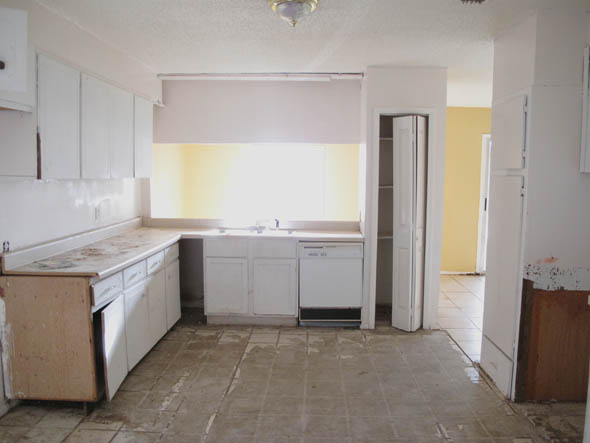
This morning the kitchen cabinets were removed from the wall to give access for electrical upgrades in that part of the house. Receptacles will be changed to GFI,s and moved to accessable ares, wiring will be concealed and cabinets remounted correctly. A previously repaired area behind the kitchen door will get a built-in shelf unit to hide that area - the wall material is no longer available and cannot be blended in. Additional lighting has already been added to the kitchen. The wall area behind the range/sink also needs repair.
See the first video of what it looks like now. I will update the videos regularly as the project progresses.
This morning the kitchen cabinets were removed from the wall to give access for electrical upgrades in that part of the house. Receptacles will be changed to GFI,s and moved to accessable ares, wiring will be concealed and cabinets remounted correctly. A previously repaired area behind the kitchen door will get a built-in shelf unit to hide that area - the wall material is no longer available and cannot be blended in. Additional lighting has already been added to the kitchen. The wall area behind the range/sink also needs repair.
See the first video of what it looks like now. I will update the videos regularly as the project progresses.
Monday, April 12, 2010
Enjoying getting back into practice

For the past week I have been doing my own rehab work on a real estate investment property. It just had too many cosmetic and minor electrical issues for most buyers. The obvious electrical issues were switch and receptacle boxes recessed behind newer drywall so that it was impossible to attach cover plates and a few lights that were slow to come on when the switch was thrown. Cosmetic issues were ugly drywall taping, no or poorly installed trim, poorly installed carpeting and a really ugly drop ceiling in the kitchen.
It has been almost ten years since I have done any real construction work but I wanted to tackle as much of this project as possible myself to keep expenses down and try to salvage a small profit. I started with the best bedroom which needed mostly drywall touch-up: replacing/repairing poorly taped seems, filling nail holes, fixing receptacle/switch boxes and building a proper cover for the main breaker box. That room is nearly ready for paint.
Every remodel I have ever done has revealed many more problems as the job progressed. I had planned to simply frame and drywall a new kitchen ceiling below what was there and drop the existing fixtures down. The wiring was a mess and the ceiling was not level, so the drop ceiling had to be removed and new wiring and fixtures installed. A problem was found in the wall of one corner and the paneling cannot be matched so a built-in cabinet is now going to cover that area. The wall behind the range and sink were not finished, with exposed wiring and plumbing. Those need to be pulled out, the area finished properly and the fixtures reinstalled.
One of the bedrooms was going to need drywall seams re-taped. Then it was discovered that the joints were cracked because the walls were water-damaged plywood over an aluminum screen-room frame. Those walls are currently being removed and will be properly re-framed, insulated and drywalled. A closet will also be added, which will hide an original exterior window in the wall between the bedroom and the living room.
Yes this was an odd house. A lot of so-so work was done by the original owners over the course of nearly 30 years. But it will soon be a nice, freshly painted home for less than $3,000 of materials and a few weeks of work. And I have really been enjoying getting back into practice with a hammer, screwdriver, multi-meter and drywall knife. It is hot and dusty but also very satisfying work where you can see your progress at the end of every day.
Labels:
drywall,
electrical,
investment,
property,
real estate,
rehab
Wednesday, April 7, 2010
Belleview Biltmore clears all legal hurdles
Things seem to be looking up for the owners of the Belleview Biltmore Resort and Spa. The appeals period for the latest court challenge of development plans has expired. Last month saw another court challenge to development of the Cabana Club site on Sand Key defeated. Both properties are owned by Latitude Management Real Estate Investors, who plan to spend over $100-million on renovations and updating. This is good news after 2 ½ years of non-stop legal battles with various groups trying to prevent the proposed development work.
The historic 113-year old resort, located at 25 Belleview Blvd. in Clearwater, was built by Henry Bradley Plant and is on the National Historic Register. The Biltmore is probably the largest occupied wood-frame structure in the world at 820,000 square feet. Since opening in 1897 the hotel saw a steady stream of prominent guests including numerous presidents, queens, kings and captains of industry from around the world. It is one of very few historic hotels in the state of Florida.
With the removal of all legal obstacles to the development, project architect Richard J. Heisenbottle said the search for funds can begin in earnest for the first time. Finding financing for the complete project as planned could be a challenge. Knowing that the project can really be built should make the financial search a little easier.
The hotel has been shuttered and more than 300 employees laid off for more than a year. At one point the hotel was paying daily code violation fines for roofing problems. The originally filed development plan called for opening the renovated resort in January 2012. The new timetable for work and re-opening is not known.
The historic 113-year old resort, located at 25 Belleview Blvd. in Clearwater, was built by Henry Bradley Plant and is on the National Historic Register. The Biltmore is probably the largest occupied wood-frame structure in the world at 820,000 square feet. Since opening in 1897 the hotel saw a steady stream of prominent guests including numerous presidents, queens, kings and captains of industry from around the world. It is one of very few historic hotels in the state of Florida.
With the removal of all legal obstacles to the development, project architect Richard J. Heisenbottle said the search for funds can begin in earnest for the first time. Finding financing for the complete project as planned could be a challenge. Knowing that the project can really be built should make the financial search a little easier.
The hotel has been shuttered and more than 300 employees laid off for more than a year. At one point the hotel was paying daily code violation fines for roofing problems. The originally filed development plan called for opening the renovated resort in January 2012. The new timetable for work and re-opening is not known.
Labels:
belleview,
biltmore,
commercial,
development,
florida,
historic,
hotel,
legal,
real estate,
resort
Monday, April 5, 2010
Why “green” is important to real estate investors

There are a lot of reason why green is in the news so much. Many of those reasons are going to become very important to everyone involved in real estate or real estate investing. Green is not just about trees and polar bears but about making homes more affordable and salable. Home buyers are interested in green and investors should remember this when doing rehabs.
Homeowners in all areas of the country benefit from living in energy-efficient houses. Well insulated walls and ceilings, thermal-barrier windows and no air leaks reduce heating and cooling bills for everyone. Installation of modern, efficient furnaces, air conditioners and electrical appliances also leads to reduced emissions, reduced raw materials extraction, reduced transportation costs and less waste in general. There are many programs at all levels of government to help homeowners pay for these types of improvements on older homes. More incentives also need to be made available for purchasing energy-efficient new homes.
Water contributes to the monthly cost of home ownership. Making a home more water-efficient can both lower operating costs and benefit the environment. Reduced water use can even delay or prevent sinkhole formation in areas prone to sinkhole activity. Low-volume toilets, shower heads and faucets all help reduce water usage. Native-plant landscaping watered with captured roof run-off can greatly reduce irrigation needs. Where available, recycled water can be used for irrigation. Tankless, or on-demand, hot water heaters save both energy and water.
Solar water heaters are an ancient and proven technology that is easily and cheaply installed and can also be adapted to heating the house. Passive solar home designs can reduce demand for air conditioning by limiting indoor direct-sun exposure during summer days and allowing cool night air into the home. Solar electric has become much more efficient and affordable than ever before and can supply much of a home’s needs during the day but storage is still a problem. Wind electric generation is just starting to trickle down to the individual home level and should become much more affordable and available during the next few years.
All of these “green” upgrades will lower monthly bills and increase salability of a home. These are not “fringe” ideas limited to the granola & chai crowd at the co-op. Mainstream home buyers are now looking for “green” features because they benefit everyone.
Labels:
efficient,
energy,
government,
green investor,
program,
real estate,
save,
solar,
water,
wind
Sunday, April 4, 2010
Investment property change of plan

I am now working on rehabbing an investment property purchased a few months ago. The original plan was to wholesale it to another investor as a rental. It was a conventional sale and the normal realtor 30 days until closing even though I was paying cash. Between contract and closing values in the neighborhood went down and sales in the area slowed to a near stop.
There still seemed to be some hope of scraping out a few dollars for a quick resale but interest was low. Soon other properties in better condition were selling for the same amount as my asking price. There was a lot of realtor interest but the slightly run-down property condition and odd floor plan put conventional buyers off. It was time to adjust the investment strategy.
The major problems with the house were old and ugly switches and receptacles, an improperly installed hung ceiling and ugly dishwasher in the kitchen and older, different-colored paint in every room. Taking care of these problems and painting the exterior trim should cost a few thousand dollars and a few weeks if I do the work myself and should make the house acceptable to a conventional buyer at a price that will leave me with a small profit. This seems like a wiser course of action than insisting on a straight resale and losing money on the deal.
In most if not all of life it pays to be adaptable and open to new ideas. I am certainly using a different strategy for the stock market than just a few years ago. Real estate investing is no different. The market is constantly changing and successful investors pay attention and make the effort to change with it.
Wednesday, March 31, 2010
Real estate investors are still doing well

I have spoken with a couple of other real estate investors working in the Tampa Bay area the past few days. Needing advice on a rehab, I was able to ask someone that has specialized in that area of investing for a long time. A meeting with another investor and friend to catch up on a few shared deals led to looking at several houses in Tampa and dinner.
The rehab specialist works mostly in Pinellas county. He has not had any problems finding distressed houses for good prices. Buyers for the updated houses have not been a problem, either. This investor likes to do “complete” rehabs, replacing all kitchen appliances and cabinets, bathroom fixtures and tile and all floor coverings as well as any windows, doors, etc… that are not in good repair. He likes to sell “the nicest house on the block”, no matter what it looked like when he bought it. Most of the work is done by the investor himself.
The other investor works mostly in Hillsborough county and used to mostly wholesale properties. He has transitioned into rehabbing most properties during the past six months, seeing it as a way to make the same amount of profit while buying and selling half as many houses. He also sees no shortage of good deals on rough houses or buyers for the repaired homes. The plan for these properties, though, is to do the least possible work to make the house presentable to a buyer and keep the selling price in line with short-sales in the area. All of the repair work is hired out.
Both of these investors noted that good labor is available at bargain prices now. The virtual halt of new home construction has left a large and idle pool of skilled workers looking for a job. This will not last forever but is helping real estate investors now.
The two investors also noted fewer properties on the market. Buyer demand has increased and they thought the flood of new foreclosures into the market had slowed slightly. Realtors I spoke with have noted this smaller inventory, too.
Labels:
buy,
county,
foreclosure,
hillsborough,
home,
investors,
pinellas,
real estate,
rehab,
repair,
sell,
tampa
Monday, March 29, 2010
How sinkholes form
Everyone knows, or at least should know, that Florida is prone to sinkholes and that sinkholes can have a very negative impact of property value. There are reasons why there is so much sinkhole activity in the state. This post will explain those reasons.
Most sinkholes occur in areas underlain by limestone, gypsum or salt. These three minerals are all easily dissolved by water, which in wet areas leads to underground cavity formation. When the roof of the cavity can no longer support the weight of the surface material above it the surface collapses into the cavity as a sinkhole. Since the hydraulic pressure of underground water also helps support whatever is above it, removal of large amounts of ground water can also lead to settling of the surface and sinkholes.
Salt and gypsum are dissolved in normal water and quite porous, so any wet climate will lead to sinkholes where these two materials are the base. Limestone is quite hard and made up of 80% to 90% calcium carbonate, usually formed by the compaction of marine life such as coral and shells. It is also prone to fissures which allow the easy passage of water. Organic material in water can form carbonic acid which dissolves the limestone.
Development activity can often lead to the collapse of otherwise stable underground cavities, thus forming sinkholes. Placing more weight on the surface above a cavity, such as settling ponds and large buildings, can cause collapse. The vibration caused by heavy highway or railroad traffic can weaken the roof of hidden cavities and lead to sinkhole formation. Removal of high volumes of ground water by farming irrigation or other commercial activities can also lead to cavity collapse or just general ground subsidence.
Any form of surface subsidence can cause major damage to any structure, roads or rails in the area. This damage can often be repaired, but repairs are usually quite expensive. The repairs generally involve mechanically jacking the structure back to its original position and then pumping the sinkhole full of concrete or other solid fill material to once again support the surface. Unless very well built, any affected structures are often either not salvageable or require extensive and expensive repairs.
Most sinkholes occur in areas underlain by limestone, gypsum or salt. These three minerals are all easily dissolved by water, which in wet areas leads to underground cavity formation. When the roof of the cavity can no longer support the weight of the surface material above it the surface collapses into the cavity as a sinkhole. Since the hydraulic pressure of underground water also helps support whatever is above it, removal of large amounts of ground water can also lead to settling of the surface and sinkholes.
Salt and gypsum are dissolved in normal water and quite porous, so any wet climate will lead to sinkholes where these two materials are the base. Limestone is quite hard and made up of 80% to 90% calcium carbonate, usually formed by the compaction of marine life such as coral and shells. It is also prone to fissures which allow the easy passage of water. Organic material in water can form carbonic acid which dissolves the limestone.
Development activity can often lead to the collapse of otherwise stable underground cavities, thus forming sinkholes. Placing more weight on the surface above a cavity, such as settling ponds and large buildings, can cause collapse. The vibration caused by heavy highway or railroad traffic can weaken the roof of hidden cavities and lead to sinkhole formation. Removal of high volumes of ground water by farming irrigation or other commercial activities can also lead to cavity collapse or just general ground subsidence.
Any form of surface subsidence can cause major damage to any structure, roads or rails in the area. This damage can often be repaired, but repairs are usually quite expensive. The repairs generally involve mechanically jacking the structure back to its original position and then pumping the sinkhole full of concrete or other solid fill material to once again support the surface. Unless very well built, any affected structures are often either not salvageable or require extensive and expensive repairs.
Labels:
florida,
limestone,
real estate,
sinkhole,
subsidence
Subscribe to:
Posts (Atom)